
Training

Shared analysis, practical skills and the experience of building collective agency together.

Courses and workshops on social movement ecology, strategy, power and the stories that keep the current order in place, for organisers, campaigns, unions and community groups. Some run as open courses; others we design with one group, around the situation it faces.

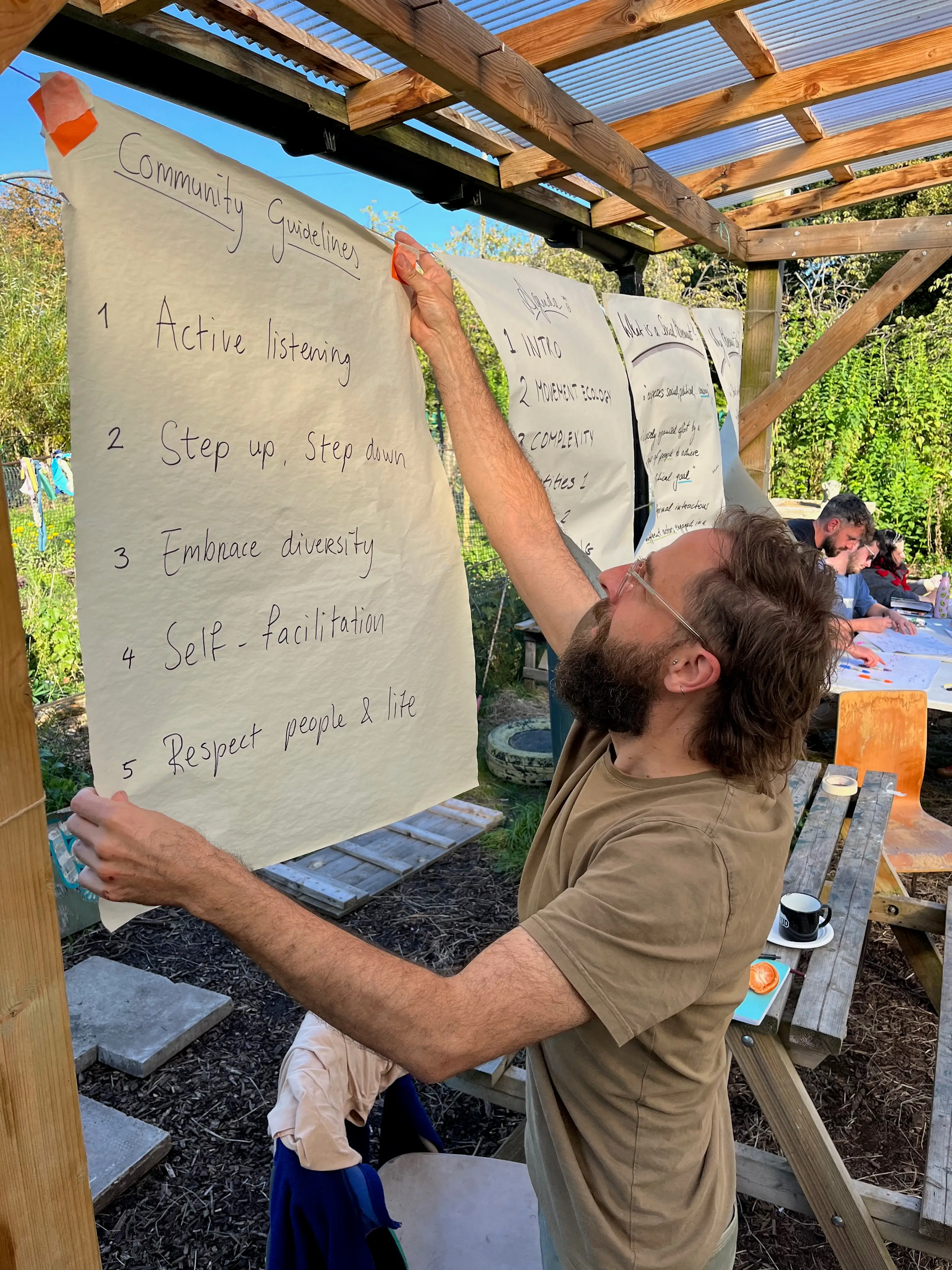
A facilitator pins a handwritten sheet of community guidelines to the beam of an open-air shelter in a garden, while participants work at a table behind him.

Why training matters

Movements move when the people in them can read their situation together and act on what they see. Our trainings build that capacity: a shared analysis of how power works and where it is shifting, and the practical skills to turn that analysis into strategy.

We teach in the popular education tradition. We start from what participants already know from their own organising and build theory from there, not the other way round.

And because collective agency is learned by practising it, our trainings are designed so that participants experience it in the room: thinking, deciding and making something together that none of them walked in with.

What we teach

Social movement ecology

Three-day course, also as a one-day introduction

A course on seeing your movement as a living system and acting accordingly. We look at how movements grow, stall and reorganise over time; why different groups playing different roles is a strength, not a problem to be solved; and how coordination can emerge without anyone being in charge. Participants leave with a map of their own ecosystem, a clearer sense of their niche in it and the connections to act on it. Draws on complexity science and the work of Rodrigo Nunes.

Developing good strategy

Strategy in a complex world

We help groups develop strategy that fits the conditions they face. Good strategy is not a wishlist or a plan on paper: it starts from a clear diagnosis of what is blocking change, puts limited time and resources where they make the most difference and commits to actions that reinforce each other rather than pull in different directions.

Strategy is something you learn by doing. And it has to sit inside a wider movement ecology, working with what others are doing, not in isolation.

Strategy over the longer term

Our next three-day course on social movement ecology runs in November 2026.

Power analysis

Hegemony theory and power mapping

We offer accessible introductions to hegemony theory, first developed by Antonio Gramsci, to help organisations and coalitions understand how the dominant order is held together and where it is breaking down. Participants map the system of power around their own issue or struggle: which groups hold power, which narratives push conformity and where crises and openings are appearing.

This feeds straight into strategy: how to disrupt your opponents’ alliances, build your own and support the emergence of new social forces. We also practise reading the moment – what Stuart Hall called conjunctural analysis – to tell which openings are real.

The narratives keeping us down

Where common sense comes from, and how to change it

Some stories have been told so long they have become common sense: about who deserves what, what is realistic, who counts. We look at where those stories come from, which ones we hold ourselves without noticing and how organising builds new common sense from people’s own experience. Practical, and connected to popular education and consciousness raising.

Bespoke sessions

Sessions on the topics your group asks for

We develop trainings and workshops to meet the needs of whoever we work with, from single groups to organisations, alliances and networks. This is how we develop a lot of our content: by groups requesting specific sessions. Groups have recently asked us for sessions on ‘why be a revolutionary?’, ‘is liberalism holding us back?’ and internationalism.

If we can’t help, we’ll try our best to find someone who can.

Get in touch

We use a sliding scale, so unfunded groups can work with us too. See fees and how we work.

Want to learn movement mapping? See Learn to map on our mapping page.

Want support beyond a single course? See accompaniment.

How we teach

Every training mixes input with discussion, games and hands-on exercises, and leaves time to apply what you learn to your own context. We adapt pace, language and breaks to the group in front of us. More on how we approach learning.

Past trainings

  • 2025 · Participatory democracy · Pelican House, London
  • 2025 · Democracy · Kairos, London
  • 2024 · Food and land justice · MUD, Manchester
  • 2023 · Climate · Plymouth
  • 2023 · Climate education · London

What people say

I was daunted by the idea of doing an education like this, but now I feel a lot more confident that I can engage and bring my perspectives.

Participant, Cooperation Hull

Finally the ‘left’ is looking at things differently and trying to work together.

Participant, social movement ecology course

Leaving feeling more connected to my community. More shared language with colleagues to talk more directly about how to focus our future planning… This feels good :)

Participant, social movement ecology course

It made me realise how important all our work is, across all social movements and all those organising for a better world. It feels like that’s already providing the basis on which something new could grow.

Participant, social movement ecology course

There were lots of cool ‘connecting the dots’ moments. I chew over these puzzle pieces so much and it was satisfying to learn how they can slot together into neater configurations, and then be broken up into new ones.

Participant, social movement ecology course

I felt re-energised to go and reach out to those that can help us on our mission to fight climate change. I have already started on some of the points we did map out. The course has given me more determination than ever.

Participant, social movement ecology course

Want a training for your group?

Tell us what you have in mind and we’ll work out a format together.